The garage-roof collector array at Drake Landing
Drake Landing's heat came from 800 glazed flat-plate solar collectors, each 2.45 m by 1.18 m, mounted on the detached garages behind the houses. Enerworks made the panels, and they fed heat into the neighbourhood's central Energy Centre.
Layout and orientation
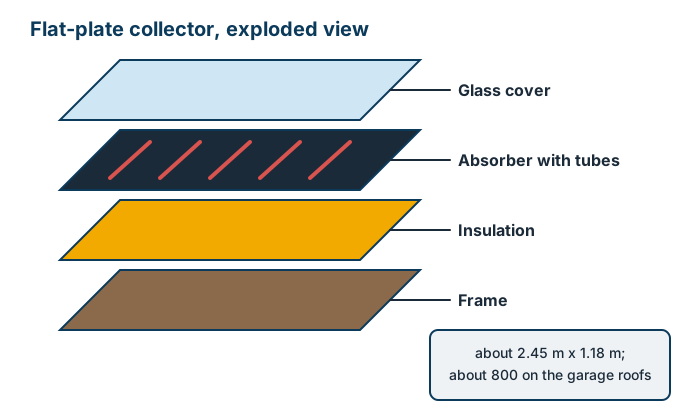
The collectors sat in four rows along the garages, two rows of panels per garage, all facing south at a 45 degree tilt. Garages measured 22 by 22 feet and were joined by covered breezeways, which created one long, continuous sloped surface. That is why the array could be so large without putting anything on the houses themselves. The homes page explains why that suited the builder.
What flows through them
Each panel carried a mixture of water and 50 percent propylene glycol, a non-toxic antifreeze that kept the loop liquid through Alberta winters. The flow through the collectors was constant while the sun was up. Pipes ran along the roof overhang, down the end of each garage and into a shallow buried trench that led to the Energy Centre.
Handing the heat over
At the Energy Centre the glycol passed through a heat exchanger and warmed water bound for the short-term tanks. The water-side flow could be varied automatically, which let the controls choose the temperature rise they wanted. Then the glycol went back to the roofs. The whole sequence is in how it works.
Year-round, not only in summer
The array ran in every season. In summer its output went mainly into the underground store. In winter whatever it collected went straight to the district loop, so sunny cold days still trimmed gas use. On a typical summer day the field produced about 1.5 megawatts of thermal power.
Sizing the field
Eight hundred collectors at 2.45 by 1.18 metres each add up to a large glazed surface, yet it hid in plain sight above the garages along the rear lanes. Output peaked in summer, when the array delivered about 1.5 megawatts of thermal power on a typical day, and the heat then travelled to the district heating loop or into storage. Early press interest in the idea is gathered in a 2005 feature on the 52 solar homes.
Before the houses existed
Because garages could be built ahead of the homes, collectors were going up while the street was still a building site. Photos from that period are in the 2006 construction timeline, and the builder's own show home is covered in the 2005 Solstice show home article. A separate, small pair of panels on each house heated tap water instead; see solar hot water.
Quick answers
How many solar collectors did Drake Landing have?
It had 800 flat-plate collectors, each 2.45 by 1.18 metres, in four rows on the garage roofs.
Why were the panels on garages and not on the houses?
Houses were built one at a time as they sold, but garages could be built first. That let the solar field be installed and run before the homes were finished.
What fluid circulated through the collectors?
A mix of water and 50 percent propylene glycol, a non-toxic antifreeze that stays liquid in winter.
Are the collectors still there?
Whether they remain on site has not been verified here. Check with the Town of Okotoks or ATCO Gas.