Rooftop solar for the hot water tap
Besides the neighbourhood heating system, every Drake Landing home had its own small solar hot water setup: two Enerworks panels, a glycol loop to a basement heat exchanger and a gas power-vent heater as backup. It was designed to supply up to 60 percent of a home's yearly hot water.
How it was arranged
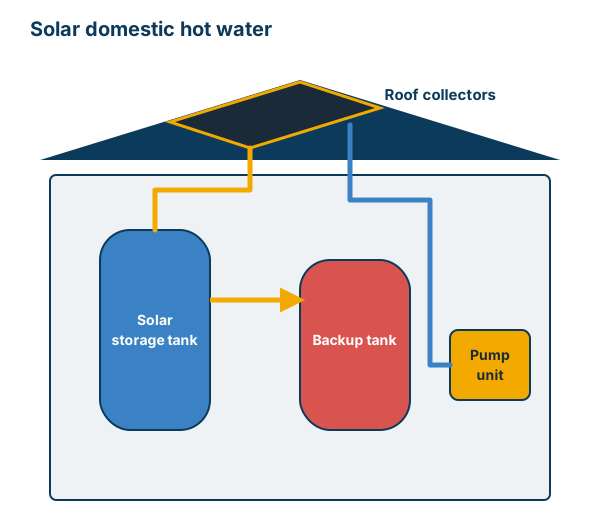
Two panels on each roof heated a non-toxic glycol solution, which ran down to a heat exchanger beside the hot water tank in the basement. The glycol let the system work through winter. The panels were self-regulating and the units were supplied by Enerworks. The orientation of the houses was chosen to favour solar collection.
Targets
The Built Green Alberta programme required at least 50 percent solar share over a year, and the units aimed for 60. With efficient power-vent gas backup and low-flow fixtures, the homes were expected to use 65 to 70 percent less natural gas for water heating than typical new houses, saving about one tonne of greenhouse gas per home each year.
Separate from the district system
This was independent of the garage-roof array, which fed space heating. Water heating stayed local because the district loop was low-temperature and seasonal. Think of it as two solar systems per street: one shared and big, one private and small.
When the sun is not enough
If the panels could not meet demand, the natural-gas power-vent water heater, coupled to the solar unit, made up the rest. Combined with the water-saving fixtures the Town of Okotoks required, this kept gas use for hot water well below normal for new houses.
A small system with a clear job
Hot water is roughly a fifth of a typical Canadian home's energy use, so a modest rooftop installation per house made sense next to the big shared system for space heating. The project's headline numbers focus on heating, but the per-home hot water savings add up across 52 houses: about one tonne of greenhouse gas avoided per home each year, as estimated at the design stage. Overall results are on the performance results page.
More about the houses
The partners behind this equipment are listed on the partners page. See the homes for the house design, the air handler for space heating, and early 2005 coverage of the groundbreaking for how the project looked at the start.
Quick answers
How much hot water did solar supply?
The units were designed for up to 60 percent annually, with a 50 percent minimum under Built Green Alberta.
What was the backup?
A natural-gas, power-vented water heater in each house.
Who supplied the rooftop panels?
Enerworks supplied the solar domestic hot water units, as well as the large collectors on the garages.
Was it connected to the district heating loop?
No. The solar domestic hot water unit in each house was a stand-alone system, separate from the shared space-heating network.