What the monitoring data showed
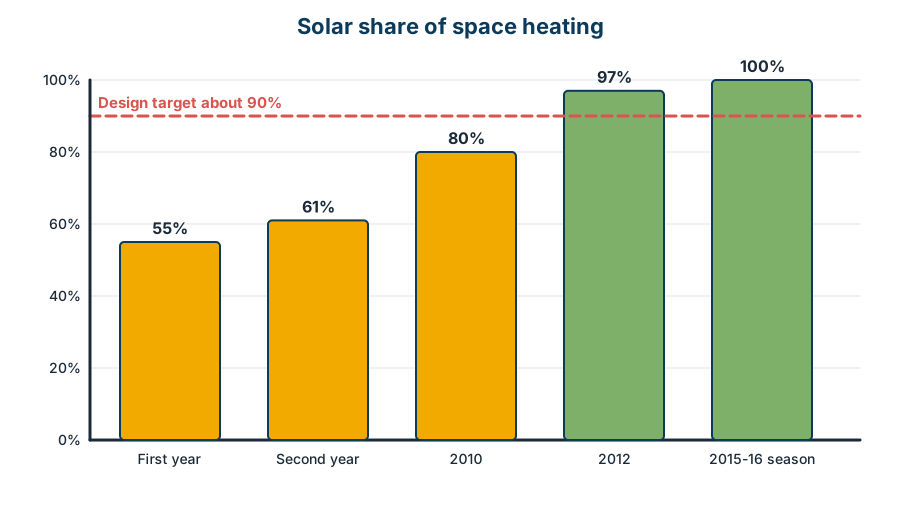
Monitoring found that the solar share of Drake Landing's space heating rose from about 90% in the first autumn to 97% by 2012, then reached 100% in the 2015-16 heating season. Monthly reports behind those figures show how the heat moved.
How the reports measured performance
Science Applications International Corporation (SAIC Canada) produced monthly summaries for Natural Resources Canada. The key measure was the solar fraction: the share of heat delivered to the district loop that came from the sun rather than from the backup natural-gas boilers. Energy was given in gigajoules (GJ). "STTS" means the short-term thermal storage tanks, and "BTES" is the borehole thermal energy storage field.
October 2007: the first full autumn
The summary for October 2007 (version 5.1, issued March 2009) shows a system still ramping up.
- Incident solar energy on the collectors: 1084.9 GJ for the month.
- Solar energy delivered to the district loop: 147.0 GJ; boilers added 16.8 GJ, for 163.8 GJ in total.
- Natural gas energy used: 17.2 GJ.
- Solar fraction for the month: 89.7%. Since 1 July 2007, 95%.
- Average solar collector efficiency: 37.0% for the month.
- Heat sent into the BTES: 250.2 GJ, against 24.87 GJ extracted. The average BTES core temperature was 42.33 degrees C, and it fell 6.14 degrees over the month.
- Electrical energy used for the month: 16.73 GJ.
May 2012: a mature system
The May 2012 summary (version 1.0, April 2013) compares the month with the period since 1 July 2011.
- Incident solar energy: 1364.7 GJ for the month; 11799.9 GJ since July 2011.
- Solar energy collected: 469.3 GJ; collector efficiency 34%.
- Energy delivered to the BTES: 316.0 GJ for May and 2211.1 GJ since July 2011. Energy extracted from it since then: 902.6 GJ.
- Energy delivered to the district loop: 96.8 GJ in May, all solar, giving a solar fraction of 100.0%. No boiler heat was needed.
- Since 1 July 2011 the solar fraction was 96.6%, with 67.6 GJ of boiler heat against 2012.5 GJ of solar heat.
- Average BTES core temperature: 53.6 degrees C in May, and 57.0 degrees C since July 2011.
The system's photovoltaic panels generated 1.4927 GJ in May 2012.
Solar fraction over time
Against the design target of about 90%, the milestones run as follows: 89.7% in October 2007; 96.6% for July 2011 to May 2012; 97% for 2012; and 100% for the 2015-16 heating season. They come from different reporting periods, so they are milestones rather than a single smooth series.
What the numbers tell us
The storage field took years to warm up. In October 2007 its core averaged in the low 40s degrees C; in 2012 the averages were above 50. The data also show how seasonal the system was: heat flowed into the field in spring and summer, and in May 2012 nothing was drawn out at all.
For the physical explanation, see borehole thermal energy storage and how it works. Early public reaction to the 80 percent mark is in the 2010 article on 80 percent solar heating, and further technical papers are listed under publications. The later decline of the community is covered in the overview.
Quick answers
What solar fraction did Drake Landing reach?
The target was about 90%. Monitoring recorded 97% by 2012 and 100% in the 2015-16 heating season.
What was the BTES core temperature?
The monthly summaries gave 42.33 degrees C on average in October 2007 and 53.6 degrees C in May 2012. The core was designed to approach 80 degrees C in late summer.
Who produced the figures?
SAIC Canada compiled the monthly summaries for Natural Resources Canada.
What does solar fraction mean?
It is the share of heat delivered to the district loop that came from the sun rather than from the backup natural-gas boilers.