The borehole field under the park: DLSC's heat store
Drake Landing stored heat in 144 vertical boreholes drilled under a small park, a buried heat exchanger known as borehole thermal energy storage (BTES). The field is about 35 m across, and its core was designed to approach 80 C by the end of each summer.
What a BTES is
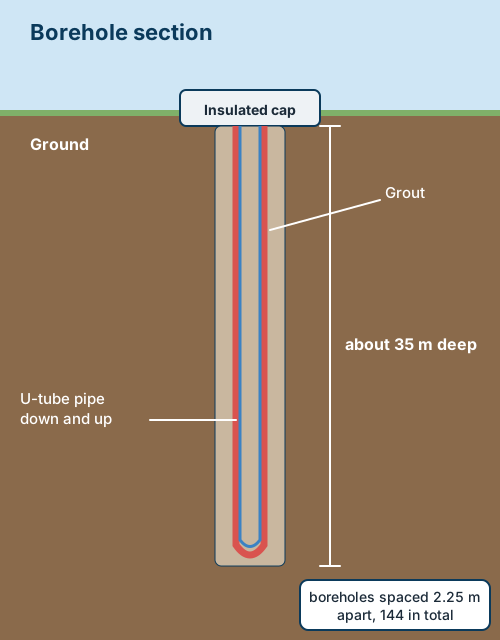
Think of a well field run in reverse. Narrow holes are drilled, a plastic U-shaped pipe goes into each, and the hole is filled with grout that conducts heat well. Warm water circulating in the pipes hands its heat to the soil and rock around them. That ground holds the warmth for months because there is so much of it and it is insulated from above.
The DLSC design
The holes are about 150 mm wide, spaced 2.25 m apart and roughly 35 to 37 m deep, in a circular field. Each hole holds a single 25 mm plastic U-tube. Pipes are joined at the surface in strings of six holes, 24 strings in all, split into four circuits across four quadrants, so losing one string would barely dent capacity. The surface is covered with insulation and soil, and a landscaped park sits on top. Pumps and valves are in the neighbouring Energy Centre.
Charging and discharging
In summer, hot water enters at the centre and flows outward, cooling as it gives up heat, so the core is the hottest part. In winter the flow reverses: cool water enters at the edge and warms as it approaches the centre. Keeping the hottest water in the middle lets the field behave like a layered store. The full heat cycle shows how this fits the collectors and the district loop.
Slow to charge
The field needed about three years of operation to build up to full temperature. Early on it ran cooler, and its recoverable heat could run out before winter ended. After that the plan was for the core to approach 80 C each late summer, enough to carry nearly a whole heating season.
Construction details
The holes were filled with a high-solids grout of blast furnace cement, Portland cement, fine silica sand and water, chosen to conduct heat well. Once piping was in, the top of the field was capped with sand, high-density R-40 insulation, a waterproof membrane, clay and landscaping materials. For public reaction after the first seasons, see this 2010 article on the project running ahead of schedule.
What the data showed, and what became of it
Monthly monitoring recorded an average core temperature of 42.33 C in October 2007 and 53.6 C in May 2012; both figures are on the performance results page. The store performed very well through the mid-2010s. The system later declined and was wound down. For the present state of the field, ask the Town of Okotoks or ATCO Gas. Photos of the drilling years are in the 2006 timeline.
Quick answers
How deep are the Drake Landing boreholes?
They are roughly 35 to 37 metres deep, 144 holes in total, spaced 2.25 metres apart.
How hot did the ground get?
The core was designed to approach 80 C by the end of summer once the field had been charging for a few years.
Why does the water flow from the centre outward?
Hot water goes in at the centre so the middle stays hottest, which helps the field keep a useful temperature gradient.
How long did the store take to charge?
About three years of operation to reach full temperature, because so much ground has to warm up first.