From summer roof to winter living room: the DLSC heat cycle
At Drake Landing, collectors on garage roofs heated glycol all year, the heat went into water tanks and then into the ground, and in winter it was pumped back through a neighbourhood loop to each home. The point was to store summer heat for months, not hours.
Step 1: collecting heat
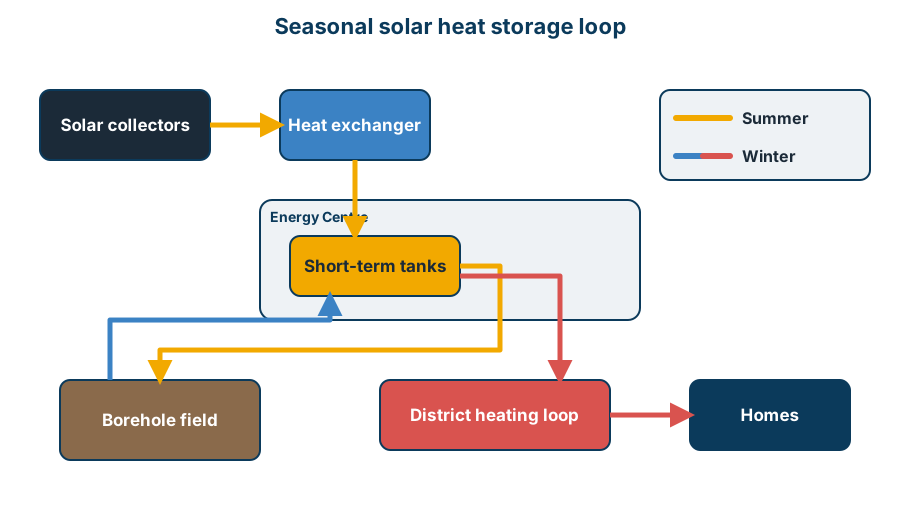
Eight hundred flat-plate collectors faced south on the garage roofs. On a typical summer day they produced about 1.5 megawatts of thermal power. A glycol and water mix ran through them, travelled along a buried pipe to the Energy Centre and gave up its heat to tank water through a heat exchanger. The cooled glycol went back up to the roofs. More detail is on the solar collection page.
Step 2: storing it for months
In summer, hot water from the tank was pumped into the middle of a field of 144 boreholes and spiralled outward through U-shaped pipes, leaving its heat in the soil and rock around them. The field is about 35 m across and the holes reach roughly 35 to 37 m deep. By late summer the core was designed to approach 80 C. On top sit sand, high-density insulation, a waterproof membrane, clay and a landscaped park. See borehole storage.
Step 3: heat for winter
When houses called for heat, cool water entered at the edge of the field, picked up warmth on its way to the centre and went to the tanks. From there a loop of insulated plastic pipe, normally at 40 to 50 C, carried it to the houses. In each basement a coil in an air-handler unit passed the heat to household air, and a valve shut off flow once the thermostat was satisfied. The pipe network has its own page, district heating.
The control logic
Heat only moves one way down the chain, and only when the upstream part is warmer than the next. Collectors switch on when the glycol is warmer than the tank. The ground pump runs when the tank is warmer than the ground. The collectors could warm the tanks about twice as fast as the ground could absorb heat, so the ground pump kept going well into the night.
In winter, collector heat went straight to the loop instead of the ground. If that fell short, the field topped it up, and if the field could not keep up either, a gas boiler in the Energy Centre covered the difference.
Site conditions and what came of it
Okotoks sits near 51.1 N at about 1,084 m elevation. The design winter temperature was -33 C and the design summer dry-bulb temperature 28.3 C. The store needed roughly three years of charging before it could carry most of a heating season. Once warm, it delivered: see the monitoring results for the solar share by year, or the 2010 article on the 80 percent milestone for how early success was received.
Quick answers
Why store heat underground instead of in a tank?
Ground is cheap per unit of heat, and a field of boreholes can hold an entire summer's collection. Water tanks big enough for that would cost far more.
Did the system need a backup?
Yes. A natural-gas boiler in the Energy Centre was there for peaks, though monitoring showed solar covering all space heating in the 2015-16 heating season.
What is seasonal thermal storage?
It means keeping heat collected in one season for use in another. DLSC did it by warming the ground in summer and drawing the heat out in winter.
How hot did the district loop run?
Typically 40 to 50 C, varying with outdoor temperature. The low temperature suits solar collectors and reduces pipe losses.