The air handler that replaced the furnace
Every Drake Landing house had an air-handler unit in place of a furnace. It drew heat from the district loop's relatively cool water, warmed household air with a fan and included a heat recovery ventilator. Nu-Air Ventilation Systems manufactured the units.
What is inside
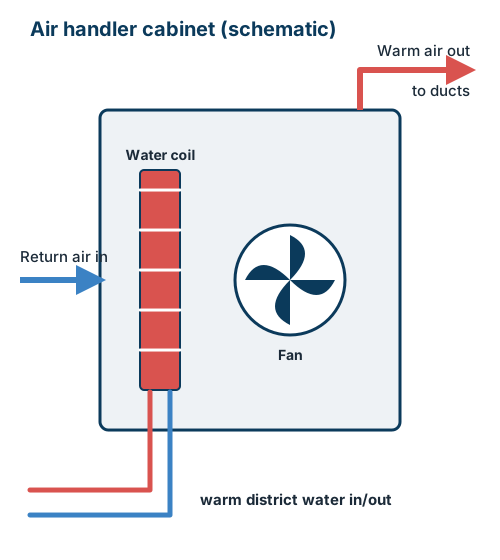
The unit has an oversized water-to-air heat exchanger, a built-in heat recovery ventilator (HRV) and a high-efficiency, variable-speed electronically commutated motor that drives both the main blower and the ventilator. It sat in the basement of each house.
How it heats
The homeowner used an ordinary thermostat. Turn it up and an automatic valve opened, letting water from the district heating loop flow through the coil. The fan then sent air across the coil and into high-volume, low-velocity ductwork. Once the set temperature was reached, the valve closed and heat transfer stopped.
Fresh air included
The HRV exhausts warm, moist, stale air from the wet rooms and uses it to pre-warm the cold fresh air coming in. That keeps ventilation up in a tightly built R-2000 home while using less energy than a conventional furnace setup.
One more detail: because the motor is variable-speed and electronically commutated, the blower and the ventilator can run gently for long periods rather than cycling hard on and off. That suits a low-temperature system, where steady, modest heat is the whole idea. The wider design of the street is explained in district heating and solar collection.
Why it was necessary
Water at 40 to 50 C is far cooler than a standard furnace coil or radiator expects, so a big exchange surface was needed. The cool loop is what made the solar design work, as described in how it works. See the homes for the rest of the house design.
Living with it
For the household the system was meant to feel ordinary: a thermostat on the wall, warm air from the registers and fresh air supplied by the ventilator. The unusual part was hidden in the basement, where the coil did the work a furnace burner would normally do. Duct design matters here, since high-volume, low-velocity air moves a lot of gentle heat quietly. The cooperating solar hot water unit sat in the same room.
The manufacturer and its story
Nu-Air Ventilation Systems is listed on the partners page for the air-handler units. A 2005 article on the company's expansion and its product for the community is summarised in Nu-Air expansion and the Enerboss at Drake Landing. After the solar system was wound down, most houses changed to gas furnaces.
Quick answers
Did Drake Landing homes have furnaces?
Not originally. They used a water-fed air handler; after the solar system closed, most homes changed to gas furnaces.
What does an HRV do?
A heat recovery ventilator swaps indoor and outdoor air while transferring heat from the outgoing stream to the incoming one.
Who made the air handlers?
Nu-Air Ventilation Systems manufactured the units for the Drake Landing homes.
Why did the air handler need a large coil?
The district loop water was only 40 to 50 C, so a large heat-exchange surface was needed to warm the air adequately.